
I went on an incredible vacation recently. I travelled to Labrador to spend a week with my BFF and we made the most of it. The thing about Labrador is that it is a vast place and the distance between destinations is long to say the least. We covered over 1500 kilometres in five days, and then add on top of that the time spent in planes and in the airport to get to and from there. My point being, there was a lot of activity but there was also a lot more sitting than I am used to doing, especially on the flight days.
I got home on a Saturday night and was back to work on Monday. As a Personal Trainer I lift a lot of heavy weights on a daily basis. Picking them up off the floor, putting them away, handing them to people…and I typically do that with ease. But on Monday, when I picked up a 50 pound weight off the floor (like I do all the time) I felt a lightning bolt of pain shoot across my back!
When I mentioned this experience to a physio friend of mine she very quickly assessed it was because my transversus abdominus (TA) muscle had shut off.
Our TA is our deepest core muscle. You can think of it like a corset that wraps around our midline, with the muscles fibres running from side to side rather than vertically up and down. It’s job is to quietly create stability. In fact, the TA (should) switch on before you even move, and without you thinking about it.
Research has shown that in healthy people, the TA activates a fraction of a second before you move your arms or legs. It is your bodies way of preparing the spine for movement before you lift, bend, reach or walk.
I was shocked that in just one week of more sitting than usual mine had decided to start to shut off. Was it giving me the silent treatment because I had ignored it all week??? 🤨
I share this as a cautionary tale and as a way to emphasize the importance of keeping our core healthy. Especially if you suffer from low back pain, or don’t want to suffer from low back pain. Which I am guessing includes all of you.
Ab Muscles
Just so we are all on the same page, we have four main ‘ab’ muscles. The most well known is the Rectus Abdominis, our most superficial one and the one responsible for giving (some of) us our six pack abs. This muscle runs up and down our body. The external oblique are a little deeper and help us with our controlled rotations and the fibres essentially run on an angle towards our front pockets and backwards toward our back pockets. The deepest Transverse Abdominis (TA) runs side to side and helps brace us and protect our back from injury.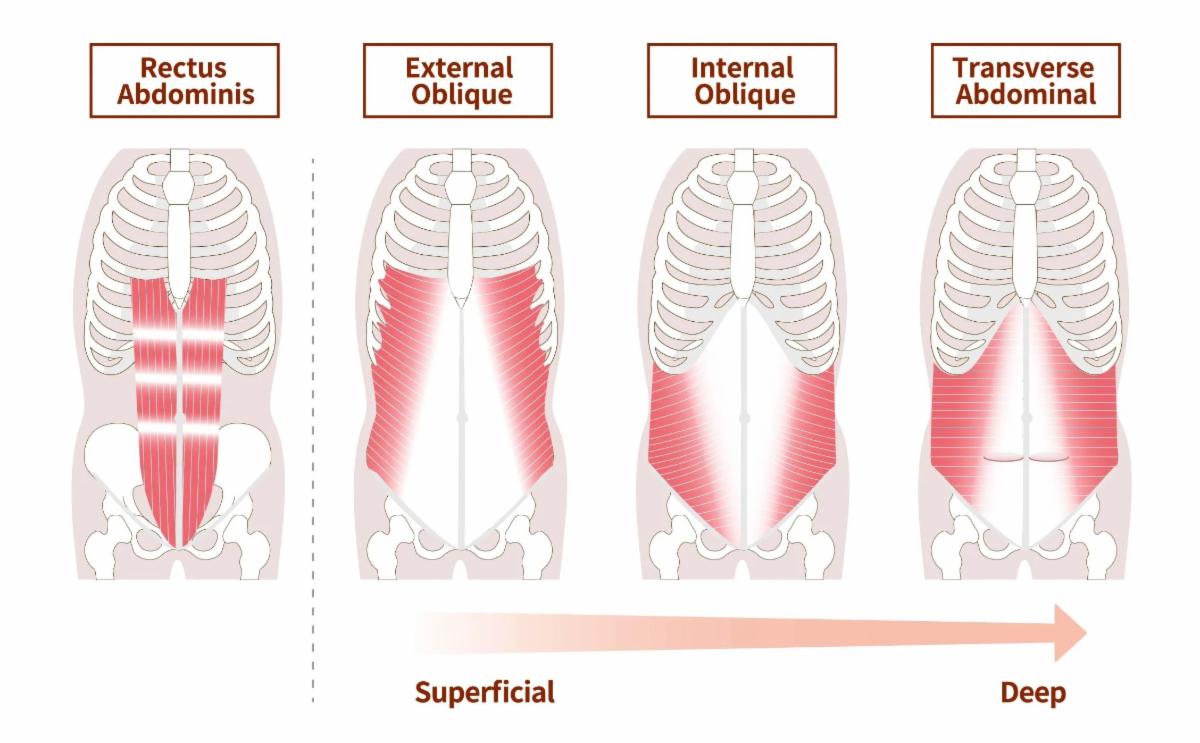
Transverse Abdominis and Friends
Your TA muscle doesn’t work in isolation. It forms part of a pressure system along with your diaphragm (above) and your pelvic floor (below) and multifidus (back). These four structures encircle your abdominal cavity and co-activate to regulate internal pressure. When you breathe in, your diaphragm descends and increases abdominal pressure. Your pelvic floor reflexively activates to counterbalance that pressure from below. Your TA tightens the walls from the front and sides.
This coordination matters for training. Contracting the TA without engaging the pelvic floor can actually push the pelvic floor downward, creating unnecessary strain and potentially weakening those muscles over time. So every TA exercise should include a pelvic floor lift as part of the activation. Think of exhaling, drawing in the lower abs, and gently lifting the pelvic floor as one coordinated action rather than three separate steps.
When the TA is not working well your body still finds ways to stablize. Many people start to:
*grip through the low back (what happened to me)get tight hamstrings
*overuse hip flexors
*tighten the neck and shoulders
*hold their breath
*brace too hard with the outer abs
How to Find and Feel the Muscle
Before you can strengthen the transverse abdominis, you need to know you’re actually engaging it. The best way to verify this is with your own fingers. Lie on your back with your knees bent and feet flat. Place two fingers on the top of your hip bones, then move them about an inch inward and an inch down. Press lightly and then imagine bracing like you are about to get punched in the stomach. When the muscle contracts, you’ll feel tension pop up under your fingertips.
Best Exercises to Strengthen the Transverse Abdominis
There are a number of exercises that are good for this but our tried and true ones are:
Dead Bugs
Lie on your back with arms extended toward the ceiling and knees bent at 90 degrees (shins parallel to the floor). Engage your transverse abdominis and pelvic floor using the drawing-in technique. Slowly extend your right arm overhead and your left leg toward the floor simultaneously, keeping your lower back pressed into the ground. Return to the starting position and repeat on the opposite side. The challenge here is maintaining that deep core engagement while your limbs move, which is exactly how the transverse abdominis functions in real life.
Planks
Planks train the transverse abdominis as part of a whole-core contraction. Research comparing different abdominal exercises found that bracing (tensing the entire core as if preparing to take a punch) actually produced higher transverse abdominis activity than isolated drawing-in alone.
Progression to Standing and Loaded Movements
The end goal isn’t to be great at lying on the floor. You want a transverse abdominis that fires automatically when you lift groceries, play sports, or deadlift in the gym. Once Planks and Dead Bugs feel comfortable, start incorporating the drawing-in activation into standing exercises: single-leg stands, cable rotations, squats, and overhead presses. The transverse abdominis should become part of your default bracing pattern during any movement that challenges your trunk stability.
As always, if you need help finding your TA or just need coaching in how to activate your core and relieve your back pain, please reach out! We are always happy to help!
xo Christine