
The Overview
Bone is living tissue that is constantly being broken down and replaced. Osteoporosis occurs when the creation of new bone doesn’t keep up with the loss of old bone, causing bones to become weak and brittle – so brittle that a fall or even mild stresses such as bending over or coughing can cause a break.
And before you log off and think you’re too young to worry about this, know that we start to lose bone density in our 30’s! The time to worry about it is right now, no matter what your age.
The Stats
- The most common fractures associated with osteoporosis are in the hip, spine, wrist, and shoulder.
- At least 1 IN 3 WOMEN and 1 IN 5 MEN will suffer from an osteoporotic fracture during their lifetime
- OVER 80% OF ALL FRACTURES in people 50+ are caused by osteoporosis
- Women and men alike BEGIN TO LOSE BONE IN THEIR MID-30S
- 22% OF WOMEN and 33% OF MEN who suffer a hip fracture will die within one year
- ONE IN THREE HIP FRACTURE PATIENTS will re-fracture within one year
- Fractures from osteoporosis are more common than heart attack, stroke and breast cancer combined.
Eating for Better Bones
It’s probably no surprise if I tell you that calcium is an important nutrient when it comes to building better bones, but did you know that protein is just as important? In fact, the benefit is two fold. Dietary protein intake plays an absolutely critical role in contributing to a higher bone mineral density, but it also makes us less vulnerable to muscle weakness, sarcopenia and frailty, all contributing to increased risk of falling.
In other words, it helps make our bones strong AND it helps makes our muscles strong so we don’t fall and risk breaking a bone in the first place.
And in case you aren’t able to get enough in your food, the three supplements that have the most evidence as being important for bone density are:
- calcium (citrate form if possible, no more than 500 mg at a time),
- vitamin D3 (600 to 800 IU minimum, more if you’re deficient) and
- vitamin K2
Being Too Fit to Fracture – Exercise for Better Bones
There is something called Wolffs Law, and it states that healthy bone adapts to the load placed upon it. If loading increases, bone remodels to become thicker and stronger; if load decreases, bone becomes less dense and weaker.
In essence, use your bones or lose your bones.
What’s important to note here is that muscles attach to bones in order to create movement, and so how we use our bones is by using our muscles. And the more we use our muscles, the stronger our bones will be. But only the bones that are attached the muscle being used. For example, if I do a body weight squat, my thigh bones might get stronger, but my spine and arm bones will not see any benefit.
This is the foundation of the findings of a landmark study, called the LIFTMOR study. It stands for Lifting Intervention for Training Muscle & Osteoporosis Rehab program. This study lasted 8 months and in that time the women were able to bring their bone density up by almost 3%!
How did they do it? In a nutshell…they lifted heavy things and they did jumping movements with impact loading.
Resistance Training for Better Bones
For the lifts they did deadlifts, squats and overhead presses. And all of them were done at what is called 85% of your one rep max, or 1 RM. Which simply means the weight is so heavy they could only lift it up to 5 times, while still maintaining good form, but those 5 reps are hard.
It’s important to note, a lot of time was spent perfecting their form to ensure they didn’t get hurt. Point being…if you want to try this and are not an experienced weight lifter, please, please, please get some professional guidance. Especially if you have low bone density.
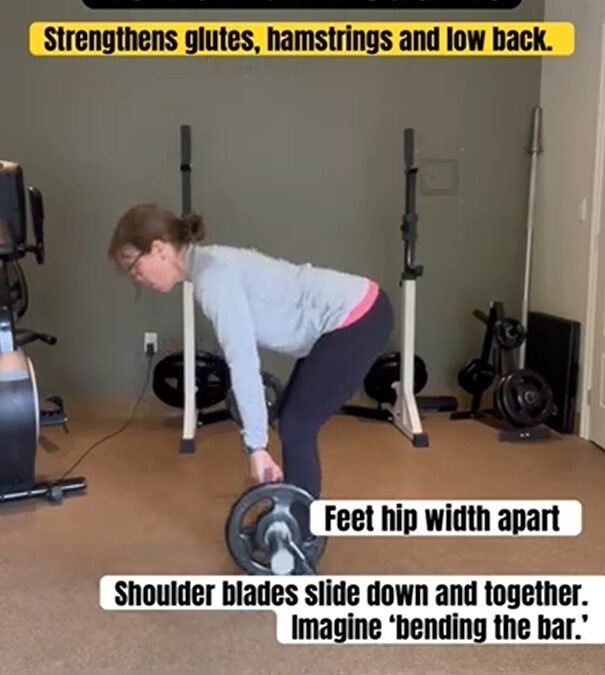
And since, most low bone density is at the top of your thigh bone and in your low back, the gold standard of exercises is a deadlift, which targets the bones in both of those areas. (Whereas squats really only target the upper thigh bone and overhead presses only target the upper body and low back…) I have included a quick video below on how to do a deadlift, but again, if you aren’t experienced I do recommend you get professional advise as this is an easy exercise to get wrong!
Jumping and Impact Training for Better Bones
As per above, when I mentioned Wolffs Law, our bones respond to the impact, or the force, placed upon them. Resistance training places force on the bones by pulling on them, and jump or impact training does the same thing.
When we do resistance training the amount of force is measured by how much weight you are lifting in pound or kilograms, whereas jump training is measured in what is called ground reaction force (GRF). GRF is explained by Isaac Newtons third law of motion, which states that for every action, there is an equal and opposite reaction. In other words, when you apply force to the ground, the ground simultaneously exerts the same force back on you. And the higher the GRF, the more bone that gets built.
For example, walking creates a GRF of 1.5x your body weight, running is 2.5x, jumping rope is somewhere in between those two (unless you use a weighted rope and that’s much better). Heel drops and impact hops can create a GRF up to 4.6 – 5.5x your body weight which means it is a great way to build or maintain bone density.
I have included a video below on how to do heel drops and impact hops if you want to give it a try!
Just keep in mind, impact loading mainly benefits the hip and femoral neck, the upper thigh bone where many osteoporotic fractures occur. That makes sense as when you land, much of the force travels directly through the legs and hips.
But those same forces don’t transfer as effectively to the lumbar spine. For spinal health resistance training is more effective. Movements like deadlifts, weighted carries, and overhead presses place direct load through the spine and upper body in a way impact alone cannot.
And a final word of caution: If you already have compression fractures, or existing foot problems or pelvic floor prolapse impact training should not be done without the permission of your doctor.
As always, if you have questions or need some guidance on building a stronger, more resilient body so you can live the life you deserve please reach out! We are more than happy to help.
Christine xo
For a more detailed overview, download our Bone Density manual below!